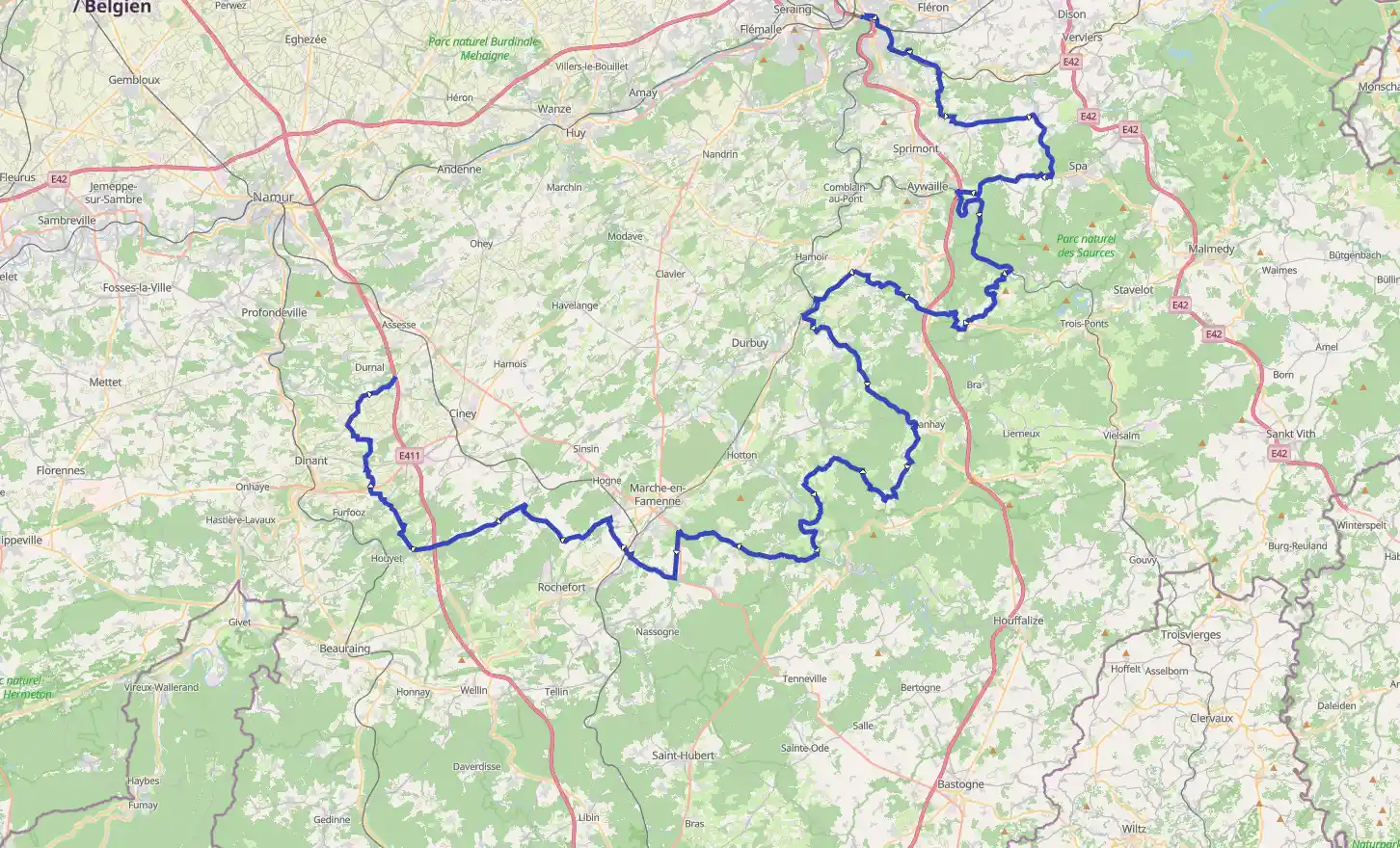
Motorcycle route through Wallonia: Chaudfontaine - Spontin
August 08, 2025

Liège, Liège, België / Belgique / Belgien
Easy
Description

No description for now...
Route
Start
4.72 km
Rue de la Pierre Blanche
50.59288, 5.63782Rue de la Pierre Blanche
RouteYou Climb Code : D_1_a
- Length : 0.53 km
- Ascent : 65 m
- Average grade : 14 m / 100 m - 13.8 %
- Maximal grade : 24.26 %
Author: Cols&Climbs@RouteYou
More information
4.94 km
Château Des Thermes
50.59122, 5.63183Château des Thermes is an exceptional prestigious place combining well-being and pleasures of the table in a stunning setting. Let yourself be pampered in a serene and refined atmosphere while enjoying the benefits of thermal water.
Be our guest in one of our 45 comfortable and cheerful rooms or let yourself be tempted by one of our majestic suites.
The spa area is composed of an outdoor thermal bath at 34°C with a hydrojet system, an indoor thermal water pool, indoor and outdoor jacuzzis, a music bath, 2 hammams, 3 indoor and 1 outdoor sauna, foot bath, infrared cabin, salt cabin, ice cabin, caldarium, relaxation rooms, herbal tea room. A bathrobe, towels and slippers are all included.
The Champagne Evening gives you access to the relaxation area in the evening from 4:30 pm to 8 pm. Enjoy a delicious gastronomic three-course meal with an offered glass of champagne as an aperitif (daily, except on Saturday).
-Leisure
-Waterpark
-Health (Wellness)
Author: Fédération du Tourisme de la province de Liège
More information
6.30 km
Source O Rama
50.58540, 5.64279Wether you are old or young, SOURCE O RAMA invites you to discover the mysteries of fresh water. Throughits educational, scientific and amusing attractions, have fun while learning, thanks to the most up to date multimedia technologies (virtual characters, interactive terminals, 4D cinema, flat screens,...). Become a waterdrop of Chaudfontaine thanks to a dynamic platform and a4D movie then experience its fabulous journey (60 yearsand 1600m underground), from the cloudto the bottle,including gushing out of the 37°C source. For groupsSOURCE O RAMA can also organize combined trips : Bottling Factory - Discover Chaudfontaine -Guided walk : The birds of our region -Guided walk : All about edible and medicinal plants -Commentated walk : Nature and history -Adventure Fort + Aquarium, Ramioul Prehistory Site and mini golf, also available for individual visitors.
-Wallonia Quality Label
-Museum/Interpretation centre
-Natural heritage
-Leisure
-Leisure centre
-Nature
-Bienvenue vélo
Author: Fédération du Tourisme de la province de Liège
More information
9.50 km
L’église Sainte-Catherine
50.57630, 5.67767
The parish church of Sainte-Catherine de Forêt-Village was built on the site of a primitive chapel dating from the 8th century (around 720). Built from sandstone and limestone blocks, the church has a slate bâtière roof. At the front is an imposing tower rebuilt in 1954. The church has a single nave of three bays to which the other parts of the current building have been added. The south side aisle was added in the 16th and 17th centuries, the chancel in the second half of the 17th century and the chapels and sacristies in the 17th, 18th and 19th centuries.
The massive tower is topped by a square slated bell tower, with openings and rounded off with a pavilion roof. It has a door lowered since 1678 and is flanked to the south by a stair turret (XXe siècle).
The nave has arched windows and the south side aisle is lit by arched windows with toothing stone surrounds. The nave consists of raised arches covered by wall paintings of foliage (16th century) supported by limestone columns. Two of them are decorated by human faces at the base (16th century?). The chancel added in 1684 ends with a chevet in three sections.
Note the wall paintings illustrating the martyrdom of St Barbe situated in the chapel in the south side aisle, as well as the choir stalls, the confessional (19th century) and the pulpit (19th century).
Listed 17 -09-1941
Author: Wizpr.guide
More information
14.51 km
Golf De Gomzé
50.54210, 5.69071The Golf de Gomzé course, set up on an area populated by centuries-old trees, winds its way through hills, plains and forests, wraps itself around small water courses, and runs alongside pretty copses of colourful shrubs. Located to the south-east of Liège, this golf course is arranged around two entirely different loops. The first nine holes, of a rougher topography, go in and out of the high forest in dapples of light and shade. The second loop runs down a little valley before entering a flat area interspersed by fruit trees and broad-leafed trees. The fully renovated clubhouse has a cafeteria with a sunny terrace, and offers a view of the 18th hole and the putting green, plus a meeting room.
-Sport and physical activity
-Golf
Author: Fédération du Tourisme de la province de Liège
More information
17.31 km
Louveigné
50.53056, 5.71278Louveigné is a village of Wallonia and a district of the municipality of Sprimont, located in the province of Liège, Belgium.
Author: Wikipedia
More information
25.90 km
Franchimont Castle
50.52768, 5.82399Franchimont Castle is a medieval castle in the municipality of Theux, Liège Province, Wallonia, Belgium. It sits at the western end of a small hill 2 kilometres south of the village of Theux, a sub-municipality.It is thought to have originally been built in the 11th century, as a stronghold of the Prince-Bishopric of Liège. The original building was extended several times during the Middle Ages, once after a fire in 1387.
Author: Wikipedia
More information
33.52 km
Côte du Maquisard
50.48928, 5.80863Côte du Maquisard
RouteYou Climb Code : D_4_d
- Length : 3 km
- Ascent : 137 m
- Average grade : 5 m / 100 m - 4.57 %
- Maximal grade : 7.74 %
Author: Cols&Climbs@RouteYou
More information
36.91 km
Hautregard
50.48805, 5.76513Hautregard
RouteYou Climb Code : D_4_d
- Length : 4.9 km
- Ascent : 210 m
- Average grade : 4 m / 100 m - 4.26 %
- Maximal grade : 6.59 %
Author: Cols&Climbs@RouteYou
More information
41.76 km
Caves Of Remouchamps
50.48010, 5.71205Enjoy the longest underground waterway in the world that’s open to tourists! You’re sure to fall under the spell of this return by ferry on the river that runs through the lower floor of the cave, over a distance of 700m. This marks the close of a tour during which you will have admired a series of subterranean beauties: spectacular galleries, marvellously decorated by nature, as well as a room that was discovered in 1912, the Cathedral, which is 40m high and could easily hold a twelve-storey building. Open to tours since 1828, today the caves are revealed in full splendour thanks to their recently fully renovated lighting.
-Built heritage
-Historic site
-Natural heritage
-Cave, cavern, archaeological site, underground
-Leisure
-World heritage properties
Author: Fédération du Tourisme de la province de Liège
More information
47.27 km
Ninglinspo
50.46875, 5.74689The Ninglinspo is a stream in Belgium, tributary of the Amblève upstream from Remouchamps around Quarreux. The valley of Ninglinspo is classed as an outstanding heritage area of Wallonia. It runs between Vert-Buisson and Nonceveux. The Ninglinspo forms rapids around enormous blocks of quartzite, forming a series of pools with evocative names.
Author: Wikipedia
More information
47.43 km
Vallon Du Ninglinspo
50.46641, 5.74377The Ninglinspo dale.
Belgium’s only mountain stream, the Ninglinspo winds through the Ardennes valley of Vert-Buisson at Nonceveux, taking you away into an enchanting world of steep paths and geological curiosities. Arising at the “fork” of the Blanches Pierres and Hornay streams, the Ninglinspo carves its way between enormous blocks of quartzite for 3.5 km and descends an incline of 7.5%. The Ninglinspo’s work in this wild dale gives rise to numerous waterfalls, as well as pools that have dreamy names: Diana’s Pool, Stag’s Pool, Pool of Venus... A real unique gem in Belgium, the Ninglinspo will delight and astonish young and old alike!
-Natural heritage
-Panorama, viewpoint, scenery
-Natural attraction, nature reserve
-Nature
-World heritage properties
Author: Fédération du Tourisme de la province de Liège
More information
49.48 km
Chefna
50.45000, 5.73333Chefna is a river of Belgium.
It springs in Ville-au-bois and flows for 5 kilometres through the province of Liège, before emptying into the Amblève.
Around 1802, several farmers started looking for gold in the river and on the right bank the pits of a primitive goldmine can be found, although they have been mostly overgrown. The river had a low yield of about 0.40 grams of gold per ton of rock, although locals still talk about the man who "almost became a millionnaire" at the end of the 19th century.
Author: Wikipedia
More information
63.05 km
Fromagerie Bio Counasse
50.37430, 5.74146Cheese types : Organic fresh, soft and pressed cow and goat milk cheeses
Since 2002, the Counasse cheese factory has been producing fresh, pressed, soft, rind and washed-rind cheeses from organic milk. “It’s my pleasure to add value to the milk from my brother Philippe's farm, which has been dedicated to organic farming since 1974. I appreciate this way of working in a short cycle,” says Vincent Counasse.
In 2014, he began producing a full range of organic goat milk cheeses, both plain or with added spices.
Tours : no
Sale : on site, Monday, Tuesday and Wednesday from 3 p.m. to 6:30 p.m., and Friday from 4 p.m. to 6:30 p.m., as well as in numerous shops and at several markets in the region
-Jam and honey
-Farm products and canned food
-Cheese
-Bio products
Author: Fédération du Tourisme de la province de Liège
More information
70.39 km
La Fromagerie Des Ardennes/bioferme
50.37741, 5.67610Cheese types : Soft and pressed cheese
Created in 1996, la Fromagerie des Ardennes is reputed for the quality of its organic dairy products, made on the basis of milk collected from neighbouring organic farms. The cheese dairy processes
cow’s, goat’s, sheep’s cheese, or all three in combination, and has a very large range of cheeses and maquées, but also milk, from crème fraîche, yoghurts, rice pudding, and more. Its philosophy has earned it numerous awards.
Tours : no
Sale : on site
-Farm products and canned food
-Cheese
-Milk and dairy products
-Bio products
Author: Fédération du Tourisme de la province de Liège
More information
77.19 km
Ferrières
50.40028, 5.60611On January 1, 2006, Ferrières had a total population of 4,449. The total area is 56.90 km² with a population density of 78 inhabitants per km².The municipality consists of the following districts: Ferrières, My , Vieuxville , Werbomont, and Xhoris.
Author: Wikipedia
More information
82.94 km
Musée Du Château Fort De Logne
50.39410, 5.54950A unique archaeological treasure in the Ardennes ! Through 5th, 6th and 7th century tombs from the Middle-Ages up to the discovery of the wells of the Logne fortified castle, the Museum invites you to meet the defenders and merceneries who lived on the fortified site for more than 1000 years. In the Museum you will find most moving accounts of the daily life of these men and women from so long ago and yet so close. Hundreds of well preserved authentic and surprising objects : jewellery, weapons, glass from the Middle Ages, daggers, bowls and china in use in the castle right up to its destruction in 1521. Don't miss the reconstruction of the tombs, 6th and 16th century tables, the Middle-Ages hut, the short film of the archaeological digs, new this year, and the animation – 3D model of the castle as it woould have been 500 years ago.
-Museum/Interpretation centre
-Built heritage
-History
-Bienvenue vélo
-World heritage properties
Author: Fédération du Tourisme de la province de Liège
More information
82.94 km
The Romanesque chapel of Saints-Pierre-et-Paul
50.39379, 5.54955
The Romanesque chapel of Saints-Pierre-et-Paul is the chancel of the old church of the same name. Mentioned for the first time in 1104, the church was built between 1130 and 1158 under the abbotcy of Wibald. The church was abandoned from the end of the 19th century and converted into a chapel. It was then decided to keep just the chancel and seal the shortened building with a neo-Romanesque façade. The chapel was restored in the 20th century by the architect A. Barentsen.
The church would have had a tower, nave and side aisles with three bays, as well as a chancel. The current chapel is formed only by the presbyterium and apse of the initial chancel. The tower and side aisles were destroyed in 1665 and the nave demolished in 1893.
This presbyterium, built in limestone blocks, is lit by two windows. The sides are decorated with arcature friezes descending to pilasters. Square in shape, it has a ridged vault ceiling. The apse has a semi-domed ceiling. The roof of the chapel is in slate. During the restoration, the lime coating covering the internal walls was removed, revealing outstanding 15th-century walls paintings on the north and south walls of the presbyterium.
Listed: 1-09-1933
Exceptional heritage site of Wallonia (wall paintings, circa 1500)
Author: Wizpr.guide
More information
111.95 km
Eglise Saint-Pierre et Paul
50.23464, 5.62240The building in the heart of the village, surrounded by a walled in cemetery and by vegetation, has a country charm. When the 1000 year anniversary of the parish was celebrated in 2012, the inside of the building was joyfully repainted. This work met the approval of the faithful and of visitors. Today the building in local stone is as new. This was absolutely necessary after the terrible destruction endured particularly during the battle of the Ardennes in 1944.
According to a 1011 charter a church already existed in Dochamps. A slab embedded in the wall recalls another destruction and a restoration in 1642 thanks to the personal skills of the two local brothers Lamornainy. Both were priests and one, William, was the confessor to Emperor Frederick II.
Inside,the stucco ceiling was restored in 1955 and the carved wood panelling is the work of Vixtor Demanet. There are also some fine wood statues including one of Christ on the Cross (18th century) and of popular saints like Roch or Anthony (19th century) as well as baptismal fonts (17th century).
Author: Wizpr.guide
More information
120.55 km
Côte de Magoster
50.25824, 5.54081Côte de Magoster
RouteYou Climb Code : D_4_d
- Length : 1.6 km
- Ascent : 71 m
- Average grade : 4 m / 100 m - 4.24 %
- Maximal grade : 8.61 %
Author: Cols&Climbs@RouteYou
More information
122.64 km
Côte de Beffe
50.24494, 5.52347Côte de Beffe
RouteYou Climb Code : D_1_c
- Length : 1.38 km
- Ascent : 123 m
- Average grade : 8 m / 100 m - 8.47 %
- Maximal grade : 12.17 %
Author: Cols&Climbs@RouteYou
More information
154.88 km
Jemeppe Castle
50.18627, 5.31360Jemeppe Castle, also known as Hargimont Castle , is a castle in Hargimont, now part of the municipality of Marche-en-Famenne, province of Luxembourg, Wallonia, Belgium.It is known that during the Roman era a fortified villa was established in the region. The present castle is however of medieval origin.
Author: Wikipedia
More information
155.09 km
Saint-Christopher's chapel, Hargimont
50.18574, 5.30999The chapel of St Christopher in Hargimont is surrounded by its old graveyard. The chapel has a Romanesque-style nave and chancel dating from the 17th century and was originally a castle chapel. The south wall bears traces of a doorway that initially provided access to the building.
The chapel was damaged during the Second World War and was finally restored between 1969 and 1971 to regain its original appearance. The building still has two funerary monuments, as well as a solid altar and pews. Some of these pews at the front of the chapel were reserved for the family of the manor, as can be seen from the partition that surrounds them. The building retained a religious function until 1875 when a new church was built.
Building listed on 29th May 1952
Author: Wizpr.guide
More information
165.63 km
Gobinette
50.20668, 5.21964Gobinette
RouteYou Climb Code : D_4_d
- Length : 1.68 km
- Ascent : 65 m
- Average grade : 4 m / 100 m - 3.64 %
- Maximal grade : 6.97 %
Author: Cols&Climbs@RouteYou
More information
180.36 km
Côte de Sanzinne
50.19333, 5.05153Côte de Sanzinne
RouteYou Climb Code : D_1_c
- Length : 1.27 km
- Ascent : 103 m
- Average grade : 4 m / 100 m - 4.19 %
- Maximal grade : 11.65 %
Author: Cols&Climbs@RouteYou
More information
190.00 km
Sanctuaire Notre-Dame de Foy
50.24709, 4.98945
Located in a beautiful unspoilt environment on the heights close to Dinant, encircled by a few stone houses, this church owes its founding to the discovery of a statuette of the Virgin Mary in a hollow tree by a woodcutter in 1609. The statue was worshipped. As a result of miracles the place became a pilgrimage site and this church was built in 1623. At this time the development of the cult of the Virgin was part of the Counter Reformation on the initiative of the Jesuits, who encouraged the cult of saints by images in reaction to the austere religion of the Protestants, who communed with God without intermediaries.
The most noteworthy feature of the building is its famous ceiling made of 145 panels of oil paintings depicting scenes from the life of Mary and portraits of saints. This ceiling is the work of the brothers Stilmant of Dinant and the painter, Guillaume Goblet. It was restored in 1935 but now needs another refurbishment. Inside, apart from the celebrated ceiling, is the miraculous statuette on the left of the altar and various paintings including ones of the Virgin and Saint Joseph.
The immediate surroundings of the church are charming with a little graveyard next to it, a small wall encircling the church, a bench for visitors, an inn, a chestnut tree, a fine view.
Author: Wizpr.guide
More information
190.64 km
The church of Foy-Notre-Dame
50.25127, 4.98652
The church of Foy-Notre-Dame was built on a site famous for its pilgrimage since the 17th century. In 1609, a woodsman found a statuette of the Virgin in an oak tree close to the "smallholding of Foy". From 1616 to 1617 a series of miracles occurred that were recognised by the Church and there was a pilgrimage to Notre-Dame de Foy.
The initial chapel was built in 1618, replaced in 1624 by the current church. The pilgrimage subsequently led to the creation of processions with routes punctuated by milestones.
The church is made up of a single nave ending in a pentagonal chevet. It was built based on plans by the architect M. Stilmant and restored in 1898-1900 by the architect A. Van Assche.
The façade is decorated with an arched door with bosses. It is flanked by pilasters supporting an ancient entablature and a pediment. In its centre, the door has a Renaissance niche that houses a copy of the statue of Notre-Dame de Foy (20th century). The façade also features the motto and coat of arms of Ferdinand de Bavière, prince bishop of Liège. The top of the tower has a square pinnacle, a convex lantern tower flanked by four pinnacles.
The narthex consists of three lowered arcades supported by Mosan-style columns. The building features a series of high windows with basket-handle arches emphasised by a stone string-course. It has an oak barrelled ceiling made up of 145 panels sculpted and painted by M. and J. Stilmant and G. Goblet, dating from 1623. These panels illustrate theological and apologetic themes. Note the Renaissance influence of the furnishings (main altar in marble), as well as the side altars in wood, the rood screen, pulpit, stained-glass windows (20th century), etc.
Listed (20-12-1982)
Author: Wizpr.guide
More information
192.30 km
Côte de Sorinnes
50.26271, 4.98067Côte de Sorinnes
RouteYou Climb Code : D_4_d
- Length : 1.26 km
- Ascent : 58 m
- Average grade : 4 m / 100 m - 4.34 %
- Maximal grade : 7.52 %
Author: Cols&Climbs@RouteYou
More information
202.92 km
Château de Spontin
50.32259, 5.00666It was built in a bend of the Bocq, whose water flows around the castle along some cascading waterfalls.The castle belonged to the noble family of Beaufort (named after a castle near Huy ). Between 1266 and 1284 Pierre de Beaufort built the main tower which is the core of the castle. In 1288 his son William (Guillaume), nicknamed the "Ardennes", participated in the Battle of Woeringen. Fore his bravery in battle, in which Henry VII of Luxembourg was defeated, he was rewarded with the fiefdom of Spontin. From that time the lords of the castle Spontin constantly added various outbuildings up to the 16th century when it gained its present form.
Author: El Pichon
More information
203.04 km
Chemin de fer du Bocq
50.32129, 5.00917Railway 128 was initially the connection between Ciney and Yvoir. It runs through the beautiful valley of the river Le Bocq over numerous bridges and through countless tunnels. Because the maintenance of this was too heavy in the costs, the line was discontinued in the early 1960s.
Today there is a tourist train 'Le Chemin de fer du Bocq'. Departing from Spontin station, the journey takes you to Ciney before returning to Spontin where the journey continues to Bauche and ends with a return to the starting point. Duration: about 1.5 hours.
There is a formula that combines hiking with the train: 'rando-train du Bocq': Over hills and valleys, this 10 km walk with French commentary between Spontin and Bauche will introduce you to the beautiful wooded valley of Bocq and its mythical railway . Return from Bauche to Spontin in a 1950s “vintage” railcar.
About 4 hours, difference in altitude of 184 m. Dirt roads and paths, very little asphalt, two small delicate steep passages. Possibility of mud in the rainy season. Minimum age: 10 years old.
Info: Rando-Train du Bocq | Le Chemin de fer du Bocq (cfbocq.be)
There are also other special trains: Valentine, Easter, Halloween, Saint Nicholas, gastronomic, ...
Author: Willem Vandenameele
More information
204.19 km
Finish